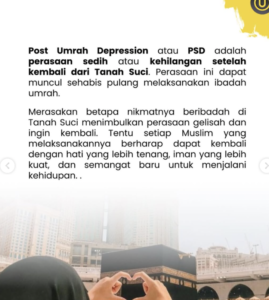
Recently, I came across the term “post-umrah depression” on social media, a concept that has been gaining attention among some travel agencies and online communities. The term seems to describe the emotional struggle some individuals face after returning from the deeply spiritual experience of performing umrah. However, I strongly disagree with the way this term is being used, especially when it is employed as a marketing tactic by umrah travel organizers and agencies.
The idea that one can only feel spiritually fulfilled or connected to Allah while in Makkah or Madinah is a misconception. Ibadah (worship) can be performed anywhere, and the closeness to Allah is not confined to certain locations. Allah is always present, and His mercy and blessings are accessible to all believers, no matter where they are. It is troubling that some travel agencies seem to exploit this emotional vulnerability to encourage people to book another pilgrimage, as if the only way to overcome such feelings is through travel.
This approach takes advantage of people’s spiritual emotions, especially when many individuals cannot afford another trip or are unable to perform umrah due to financial constraints. “Post-umrah depression” is, in my opinion, an artificial construct designed to generate profits, and it trivializes the true purpose of ibadah, which is to strengthen one’s relationship with Allah and live with sincerity in daily life, not just during a pilgrimage.
It is crucial to remember that true spirituality is not bound by time or place. Those who are unable to perform umrah can still cultivate a strong connection with Allah through consistent worship and devotion. Using such emotional tactics to profit from people’s spiritual desires is both unethical and unfair.
We should be more mindful of the fact that many people, especially those who are less fortunate, cannot afford to go on umrah. We should not exploit their religious desires for profit. The true essence of Islam lies in sincerity and worship, which can be practiced at any time and place, not just during the pilgrimage.